

Today's MSR has developed a strict policy of refusing to leave the house without an optic. Iron sights still work, of course, but they’re a bit like using a flip phone in a smartphone world, that is, functional, nostalgic, and not exactly what most shooters are reaching for anymore.
For a long time, determining your choice of optic was simple.
If you wanted fast shooting up close, you bought a red dot.
If you needed zoom, you bought a scope.
Now there’s a third option in the 1x optic world: the micro prism sight. Designed to compete in the same close-range role as a red dot, it uses a completely different optical system to get there.
The micro prism vs. red dot debate can feel a little confusing at first because both are 1x optics. Both are fast. Both work with both eyes open. But they are built differently, and that changes how they feel on a rifle.
So which one should you pick? It really comes down to how you use your AR.
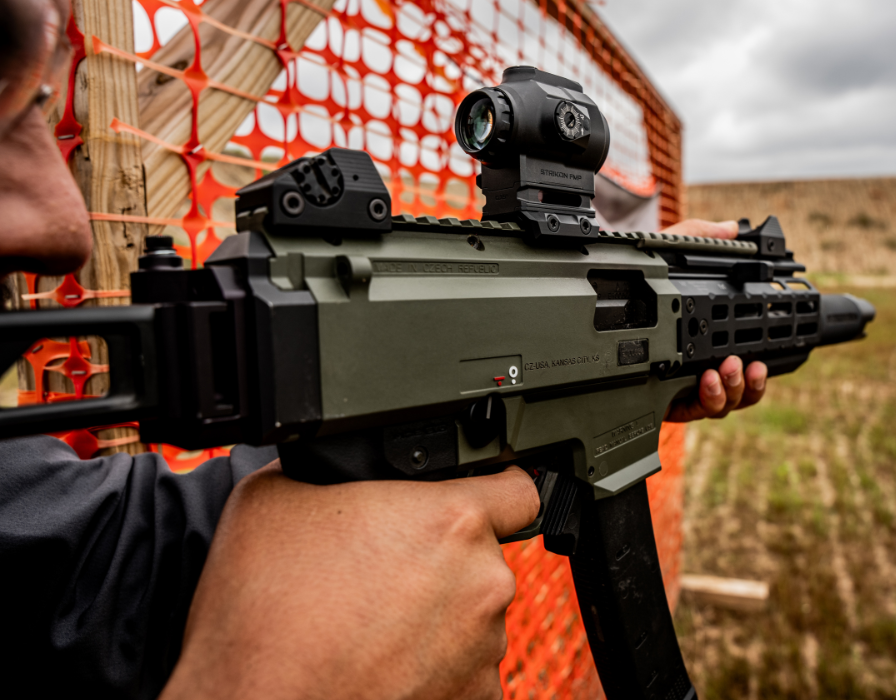

How a Micro Prism Works
A red dot is about as straightforward as it gets. It shines a dot onto a lens, then you put the dot on the target and press the trigger.
A micro prism works more like a compact scope. Inside is a prism system, and the reticle (the aiming mark) is etched into glass.
That one difference matters more than it sounds like it should.
Prism Sights Work Without Batteries
If the battery dies on a red dot, the dot is gone.
On a prism like the Sightmark Strikon FMP 1x18, the etched reticle is still there. As long as there is enough ambient light, you can still see and use it through the glass.
Illumination just makes it easier to pick up. It is not what creates the reticle.
The FMP also gives you 12 brightness settings, including night vision modes, so you can dial it in for everything from bright daylight to low-light or NV setups.
You are not completely dependent on electronics to aim. That adds a layer of redundancy to your rifle that some shooters really value.
Reticle Clarity and Astigmatism
If you’ve ever looked through a red dot and seen a fuzzy starburst instead of a clean point, you’re not alone. That’s often astigmatism at work.
A micro prism can look cleaner to some shooters because the reticle is etched and optically focused through glass instead of being projected as a single LED point.
The FMP also includes a diopter adjustment, so you can fine-tune the focus to your eyes and get the reticle as sharp as possible.
Important note:
This is not universal. Some people see red dots just fine. Others prefer prisms immediately. If you can, it’s worth looking through both before deciding.
A clearer aiming point can make shooting feel faster and more consistent, especially if your eyes don’t love traditional red dots.
What About Parallax?
You’ll hear “parallax-free” thrown around a lot, but in reality, no optic is truly free of it.
The FMP is set for about a 50-yard parallax point.
In plain English: small shifts in your head position can slightly move the point of aim, but it’s designed to be minimal for typical AR distances and fast shooting.
Good fundamentals still matter. Even with a 1x optic, consistent head position helps you stay precise as distance increases.
Where Red Dots Still Win
Red dots are popular for a reason, and it’s not just tradition. With a red dot, you don’t need a perfect head position. If you can see the window, you can usually see the dot.
That makes them extremely fast when you’re moving, shooting from awkward positions, or not perfectly squared up behind the rifle.
A prism has an “eye box.” You need to be behind it correctly to see the full image clearly.
The FMP does a good job here (3.85 inches of eye relief helps), but it still can’t match the near-infinite forgiveness of a red dot in extreme positions.
Red dots are also usually lighter and mechanically simpler. The FMP comes in at about 6.9 ounces with its mount, which is still very compact, but not quite as minimal as the lightest red dot setups.
Less weight and fewer optical constraints can make a red dot feel a little more instinctive when everything is happening fast.
Best use cases for red dots:
- Pistols
- Very light rifles
- Close-range carbines
- Fast shooting from odd positions
If your goal is simply “put dot on target and shoot,” red dots are still hard to beat.
Why a Micro Prism Can Be Better for a Duty or Do-It-All Rifle
A general-purpose AR lives a different life than a range toy. It might sit untouched for months, then need to work immediately when it matters.
That’s where prisms start to make a lot of sense.
Battery is not the whole story
The FMP battery life breaks down roughly like this:
- ~100 hours (high power)
- ~1,000 hours (medium)
- Up to ~10,000 hours (low)
It also includes Shake Awake, so it powers up when moved.
But here’s the key point:
Even if the electronics stop working, the reticle is still there.
You always have a usable aiming reference, even without power.
Night vision support
The FMP includes dedicated low settings for night vision use.
If the reticle is too bright under NV, it can wash out your view. These lower settings help keep things usable without overwhelming the image.
It plays nicely with more setups, not just basic daylight shooting.
Built for real-world abuse
The FMP is:
- Aluminum-bodied
- IP67 waterproof
- Fog resistant
- Shock tested to military-style standards
It’s meant to survive drops, weather, and rough handling without losing zero or giving up on you.
Mounting Height Matters
Height changes how the rifle feels more than most people expect.
- Lower mount = more traditional cheek weld and tighter feel
- Higher mount = more upright head position and faster transitions for some shooters
Red dots often follow co-witness conventions with irons. Prisms don’t always fit neatly into that same system because their optics behave differently.
The FMP gives you options:
- 1.15"
- 1.54"
- 1.93"
- 2.32"
You can actually tune the setup to your body, your gear, and your shooting style instead of forcing yourself into one fixed height.
Who Should Use a Micro Prism?
There’s no single “best” optic for everyone, but prisms really shine in a few specific roles.
1. Duty / defensive rifles
- Backup aiming if power fails
- Weather resistance
- Night vision compatibility
Why: reliability matters more than simplicity.
2. Hunting rifles (short range)
- Great in brush and woods
- No need for magnification
- Still usable without a battery
Why: simple, tough, and dependable.
3. Competition shooters
- Fast transitions
- Clear etched reticle
- Wide field of view
Why: some shooters prefer a defined aiming reference over a floating dot.
4. “One rifle for everything” builds
- Training
- Home defense
- Hunting
- General range use
Why: it balances speed, durability, and redundancy in one optic.
Micro Prism vs. Red Dot: Simple Answer
Here’s the quick version:
Pick a red dot if you want:
- Lightest possible setup
- Maximum simplicity
- Most forgiving sight picture
- Pure close-range speed
Pick a micro prism if you want:
- Etched reticle (works even without power)
- Potentially clearer aiming for your eyes
- More durable, all-weather setup
- A more versatile 1x optic overall
Micro Prism vs. Red Dot FAQ
What is the main difference between a micro prism and a red dot?
A red dot projects an illuminated aiming point onto a lens. A micro prism uses a prism optical system with a reticle etched into glass. Both can serve as 1x close-range optics, but they create the aiming reference in different ways.
Will a micro prism still work if the battery dies?
Yes. On a micro prism such as the Sightmark Strikon FMP 1x18, the etched reticle remains visible in sufficient ambient light even without illumination. The battery powers the illumination, not the reticle itself.
Is a micro prism better for astigmatism?
It can be for some shooters. An etched reticle may appear cleaner than a projected red dot, and the Strikon FMP includes a diopter adjustment for focus. The effect is not universal, so it is worth looking through both optic types if possible.
Do micro prism sights have eye relief?
Yes. Unlike a red dot, a prism has an eye box and requires the shooter to be positioned behind the optic. The Sightmark Strikon FMP 1x18 provides 3.85 inches of eye relief.
Why would someone still choose a red dot?
Red dots are typically very forgiving about head position, simple to use and often lighter. That can make them especially fast on pistols, lightweight rifles, close-range carbines and when shooting from awkward positions.
Which is better for a duty or general-purpose AR: a micro prism or a red dot?
It depends on the rifle and the shooter. A red dot favors simplicity and a forgiving sight picture. A micro prism adds an etched reticle that remains usable without power, plus features that can make it attractive for duty, defensive and do-it-all rifles.
Final Take
Red dots are still the simplest, fastest option for close-range shooting. That’s not changing anytime soon.
But micro prisms bring something different to the table: a built-in backup aiming system and an etched reticle that some shooters find easier to work with.
The Sightmark Strikon FMP 1x18 is built around that idea. It’s not trying to replace red dots—it’s offering another way to solve the same problem, with more redundancy and flexibility baked in.
If your AR is the kind of rifle you want to grab and trust without thinking twice, a micro prism is absolutely worth a look.
0 comentarios